


In a market increasingly saturated with promises of autonomous agents and “AI employees,” few products have positioned themselves as aggressively as Genspark’s flagship tool, Genspark Claw. Marketed as a system capable of handling workflows ranging from email management to social media publishing and operational automation, Claw represents a bold vision to replace fragmented SaaS stacks, and even human labour, with a single, intelligent layer. And it is priced as such.
But beneath the surface, a very different narrative is emerging. One that raises uncomfortable questions about transparency, product readiness, and the widening gap between AI marketing and AI reality.
The Cost of Autonomy, Without the Autonomy
Claw is not cheap. At scale, users report needing to spend upwards of $800 per month to operate the system half effectively. That figure might be justifiable, if the product delivered consistent, reliable output.
Instead, the cost structure appears opaque and volatile. Token usage, the fundamental pricing mechanism underpinning most AI systems, is neither clearly communicated nor predictable. Tasks that appear simple on the surface can consume 10–30% of a user’s monthly allowance in a single execution. There are no meaningful warnings when limits are approaching, and no granular visibility into how tokens are being burned.
Worse still, users have reported overnight pricing shifts, costs increasing by an order of magnitude without adequate notice. For a platform positioned as a business-critical tool, this introduces an unacceptable level of financial uncertainty.
The irony is difficult to ignore. A system designed to optimise operations may itself require constant cost monitoring just to remain viable.
A Product That Doesn’t Quite Work
At the heart of the criticism lies a more fundamental issue. Reliability.
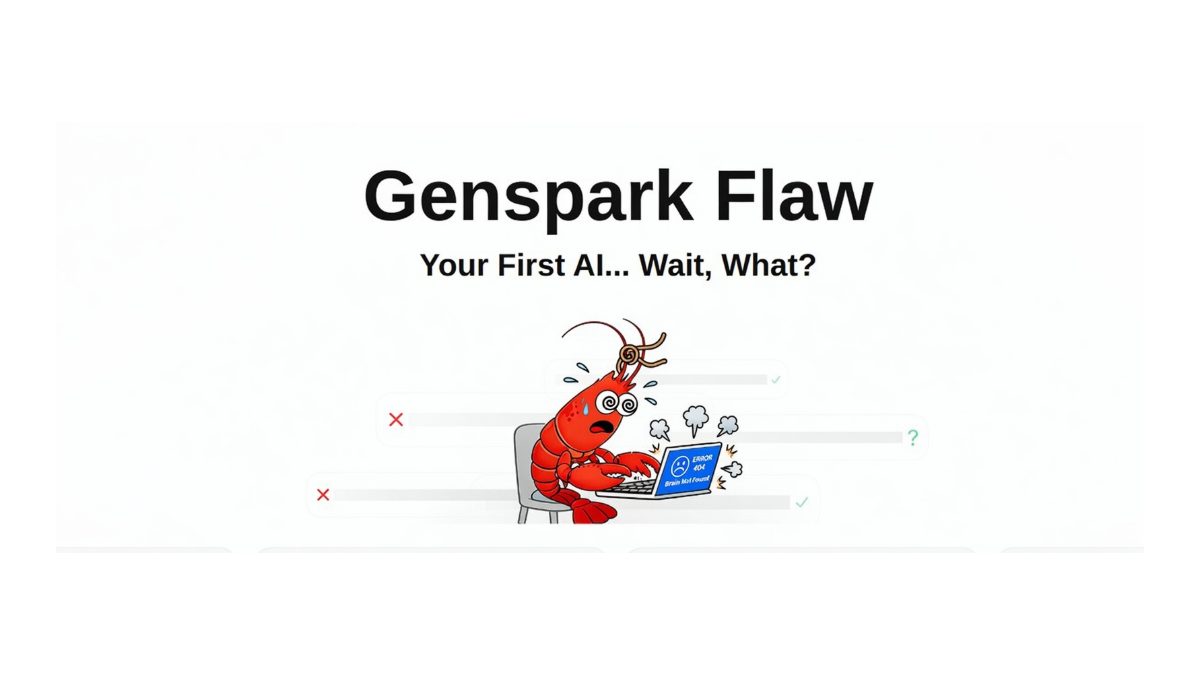
Claw is marketed as an “AI employee”, a phrase that implies consistency, memory, and the ability to execute tasks with minimal oversight. In practice, it behaves more like a perpetually confused junior hire.
Tasks fail to complete. Instructions are not followed consistently. Processes that worked once cannot be reliably repeated. Memory, a core requirement for any autonomous system, is described by users as “weak at best.”
Even basic infrastructure appears unstable. Scheduled tasks (crons) frequently fail to run. Integrations disconnect. Configuration often needs to be manually checked and reset before each use. In many cases, Genspark Claw simply fails to connect at all.
The cumulative effect is not just frustration, it’s erosion of trust. Automation only works when it is dependable. Without that, it becomes another layer of operational risk.
Genspark’s strategy is rapid iteration, relentless feature releases, and heavy marketing investment. New capabilities are launched weekly, often accompanied by bold claims about productivity gains and business transformation.
But speed has come at a cost.
With the exception of a handful of more stable tools, namely Slides and Sheets, much of the broader ecosystem appears underdeveloped. Features are released before they are ready, creating a cycle where users are effectively testing unfinished products in live environments.
Claw itself embodies this tension. It is positioned as a fully-fledged automation agent, yet struggles with foundational tasks:
- Email management that introduces errors rather than efficiency
- Social media posting without support for essential assets like images
- Community management (e.g. Discord) that lacks reliability and consistency
The underlying philosophy appears to prioritise shipping over stability. “Launch it, even if it’s not working” may accelerate visibility, but it undermines long-term credibility.
The Illusion of Optimisation
One of the more contentious aspects of the platform is its approach to cost control. Users are advised to “optimise” token usage, but in practice, this often translates into limiting usage altogether.
In other words, the most effective way to manage costs is simply to use the system less.
Compounding the issue is the apparent reliance on cheaper large language models (LLMs) in certain workflows to cut cost. While positioned as efficiency gains, these substitutions often degrade output quality to the point where results become unusable. What is presented as optimisation can feel more like corner-cutting.
The Missing Customer Support
For a product operating at this price point, and targeting business users, the absence of customer support is striking.
Users report little to no access to meaningful assistance. Issues persist without resolution. Documentation is limited, and troubleshooting becomes a self-service exercise in trial and error.
This is particularly problematic given the platform’s complexity. When systems fail, and they frequently do, there is no safety net.
Genspark is investing heavily in marketing. Its messaging is polished, its vision compelling, and its ambition undeniable. The idea of an “AI employee” resonates in a world where businesses are actively seeking leverage.
But the gap between promise and performance is becoming harder to ignore. Claw does not yet replace an employee. It does not reliably reduce workload. And it does not offer the predictability required for mission-critical operations.
Instead, it introduces a new category of overhead. One that combines high costs, operational friction, and the need for constant supervision.
Genspark is not alone in this trajectory. The broader AI sector is grappling with similar tensions, between speed and stability, innovation and execution, narrative and reality.
What makes Genspark Claw notable is the scale of its ambition. By positioning itself as a replacement for human labour, it invites a higher standard of scrutiny. And at present, it falls short of that standard.
Genspark Claw is not a failure of vision. The concept of autonomous agents capable of handling real business workflows, is where the market is heading.
But today, Genspark Claw feels less like the future of work and more like an expensive prototype.
Until the fundamentals are addressed (transparency, reliability, cost control, and support) it remains difficult to justify as a serious operational tool. For now, businesses would be wise to treat it not as an employee, but as an experiment.
And an expensive one at that.
Author Profile

- I have been writing articles about finance, the stock market and wealth management since 2008. I have worked as an analyst, fund manager and as a junior trader in 7 different institutions.
Latest entries
- May 19, 2026Global Economics2FA “Security” Is Costing the Economy $100 Billion While Hackers Keep Winning
- April 30, 2026NewsWireGenspark Claw, the Genspark Flaw: When “AI Employees” Become Useless Interns
- June 4, 2025NewsWireHow Webmasters Are Paying the Price for the AI Boom
- April 24, 2025NewsWireCapital One-Discover Merger Reshaping the Credit Card Industry