


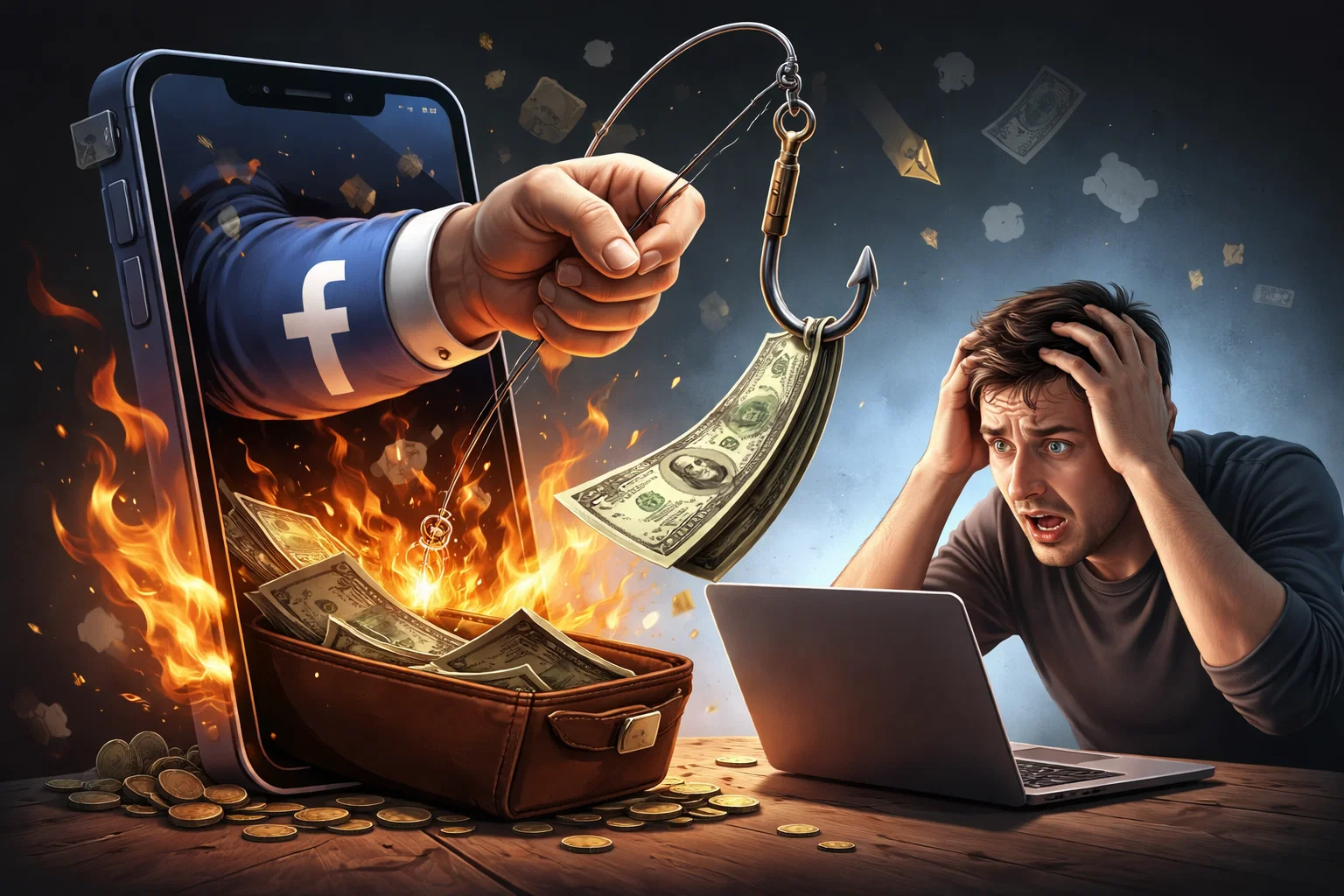
The revelations emerging from internal Meta documents, leaked to Reuters and now circulating through political and regulatory spheres, offer a disturbing portrait of a platform willing to tolerate mass fraud in pursuit of revenue. If accurate, the findings point to a company that has quietly become a financial artery for organised online scam operations, while simultaneously profiting from those same criminal campaigns.
The numbers alone are remarkable. According to the leaks, 10% of all Meta revenue comes from scams and banned goods advertising, roughly $16 billion a year. This is not revenue from borderline material or ambiguous “grey areas,” but from activity explicitly forbidden by Meta’s own policies.
Worse still is the apparent scale of harm inflicted on users. The company reportedly estimates that it has been involved, directly or indirectly, in one-third of all successful scams in the United States. If true, this would mean Meta’s ad infrastructure is facilitating roughly $50 billion in annual scam-related losses to American consumers, losses mostly borne by individuals too vulnerable, too trusting, or too poorly protected by regulatory frameworks to stand a chance.
These revelations are suffocating in implication: a company that built its business on connecting people now accused of knowingly connecting criminals to their victims.
One of the most explosive case studies in the leak concerns the role of Chinese advertising networks. In 2024, Meta generated more than $18 billion from Chinese businesses targeting foreign consumers, overwhelmingly in the United States, Europe, and Latin America.
Internal analysis reportedly showed that around 19% of that revenue was tied to scams or prohibited content. That equates to more than $3 billion per year, much of it coming from networks believed to be criminal in structure and intent.
An internal anti-fraud team, working quietly behind the scenes, managed to cut these ads in half. By normal ethical logic, that would constitute success. By company logic, however, it constituted a business threat. When the revenue drop reached senior leadership, Mark Zuckerberg allegedly instructed staff to “pause” the crackdown, and the team was disbanded.
Predictably, the problem rebounded. By mid-2025, the percentage of banned ads associated with Chinese accounts had climbed back to 16% of all China-sourced revenue.
The consequences of that rebound are not abstract. If these figures are credible, the platform is effectively channelling stolen money out of American households and into the pockets of foreign criminal organisations.
A Structure Built to Fail
Another striking pattern in the leak is structural: Meta appears to have set internal revenue-protection thresholds so tight that effective anti-fraud action was impossible.
Fraud may generate 10% of company revenue, but internal teams were reportedly blocked from taking any action that risked more than 0.15% revenue loss. The arithmetic is bleak. Damaging fraud could be choked off, but only if it was small enough to be meaningless. Anything real was out of bounds.
At the same time, Meta allegedly charged higher CPM rates to suspected scam advertisers, creating what some insiders described as a “scam tax.”
If the reporting holds up, Meta did not just tolerate scam operations, it monetised them, priced them, and integrated them into the machine.
Perhaps the most unsettling allegation is that the system does exactly what it was built to do: locate profitable customers and feed them more ads.
For legitimate businesses, that is the entire point of programmatic targeting. But when the “businesses” are scams, the same machinery becomes a weapon.
The leaked documents describe how Meta’s algorithm identifies users most vulnerable to fraudulent ads and continues to show them the same material, refining and personalising their exposure until conversion is achieved.
In other words, Meta is accused of engineering a feedback loop of financial victimisation: those who fall once will be shown how to fall again.
One would imagine a global corporation would fear the legal implications of defrauding millions of people. Yet the leaks indicate that Meta anticipated the regulatory blowback.
The documents suggest the company projected up to $1 billion in fines, but shrugged, because the business line was generating $3.5 billion every six months.
If accurate, this represents a deliberate internal reckoning: the damage to consumers, and the legal consequences of enabling it, were more than offset by the profit it produced.
The moral framing is chilling. Fraud was not a crisis. It was a business model.
US Senators Richard Blumenthal and Josh Hawley have now issued a blistering letter calling for FTC and SEC investigations. The letter argues that Meta not only permitted widespread fraud, but did so at the same time it was cutting safety teams and redirecting billions into VR and AI investments.
That contrast, safety divested, risk monetised, capital redeployed, is hard to ignore. The optics are punishing.
Regulators now face a difficult calculus. If Meta is enabling systemic, industrial-scale fraud in the United States, then the issue is not merely compliance, it is public protection.
What This Moment Actually Means
The numbers are the numbers, and they will dominate headlines. But the larger story runs deeper.
The suspicion hanging over Meta is not just that it failed to stop fraud, many platforms struggle with that. The allegation is that Meta made itself a profit-maximising participant in fraud, right down to the mechanics of pricing, targeting, and policy enforcement.
If these documents are validated, then the basic trust contract between Meta and the public, already frayed beyond recognition, may be approaching collapse.
In the end, the question facing regulators, users, and investors is not technological. It is more existential.
How do you regulate a platform that allegedly earns billions from crime, calculates liability as a cost of business, and dismantles the teams that get too close to fixing the problem?
It is far easier to say the world cannot afford that kind of company, than to build the world that stops it.
Author Profile

- Lucy Walker covers finance, health and beauty since 2014. She has been writing for various online publications.
Latest entries
- June 4, 2026Global EconomicsEconomics and Reliability of Agentic AI in Enterprise Use
- December 20, 2025NewsWireWhat Reuters Meta Scam Leak Says About the World’s Largest Social Network
- December 14, 2025Global EconomicsHow Parliamentary Immunity Undermines Europe’s Financial Union
- June 30, 2025NewsWireBank Savings at Risk: The Dark Side of EU’s Savings Standard